Leopard Print Libbey 16oz Can Glass SVG
A Designer’s First Glance: Bold, Playful, and Unexpectedly Versatile
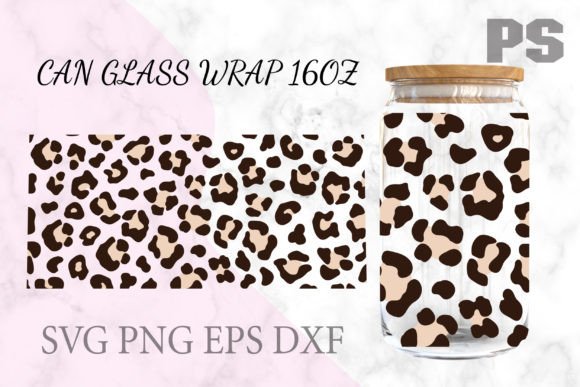
When I opened Leopard Print Libbey 16oz Can Glass SVG, I wasn’t expecting a design that would spark ideas for embroidered totes, baby onesies, or even boutique aprons—but it did. At first glance, it’s unmistakably graphic: a stylized can silhouette wrapped in high-contrast leopard print, clean lines, no gradients or photorealism. It reads as confident, cheeky, and modern—not kitschy, not dated. That matters. In embroidery, where texture and scale shift everything, a design this sharp translates well into stitch without needing heavy reinterpretation.
Real Project Test: Embroidering a Custom Tote for a Local Café Pop-Up
Last week, I used Leopard Print Libbey 16oz Can Glass SVG as the centerpiece for a limited-run embroidered canvas tote—meant for a neighborhood coffee shop’s summer launch. I converted the SVG to an embroidery file using my digitizing software, scaled it to 4.2” wide, and stitched it on medium-weight natural canvas with black thread on cream fabric. The result? Crisp edges, balanced negative space, and zero crowding in the leopard spots—even at that size. Customers paused to touch the stitching, commenting on how “lively but polished” it felt. That’s the sweet spot: a machine embroidery design that looks intentional, not auto-traced.
Where It Shines—and Where to Pause
Leopard Print Libbey 16oz Can Glass SVG works beautifully on structured, stable fabrics: denim jackets, cotton tea towels, twill caps, and linen pillow covers. Its bold outline and rhythmic pattern hold up in satin stitch and fill stitch alike—no fragile micro-details that vanish in dense stitching. As an applique design? Equally strong: the can shape gives clean cut lines, and the leopard motif reads clearly even when fused and topstitched.
But be thoughtful on stretchy knits (like lightweight sweatshirt fleece) or thin voile—those require extra stabilizer and possibly simplifying spot density manually. On dark fabric, test contrast early: leopard prints rely on value shifts, so charcoal thread on navy may mute the effect unless you boost stitch density slightly or add a white underlay. And avoid placing it directly over seams or curved surfaces like cap crowns without re-hooping—it’s a flat-layout design, not engineered for 3D distortion.
What This Means for Your Craft Business
- Customer trust rises when your embroidered patch or custom apparel looks cohesive—not like a resized clipart sticker. This design has inherent rhythm and proportion, so it feels like part of the product, not pasted on.
- Giftability increases: Leopard print signals fun and confidence—ideal for personalized gifts like baby blankets (paired with a monogram), holiday kitchen towels, or bridal shower totes. Buyers don’t just see “leopard”—they see *intention*.
- Etsy sellers and small shop owners will appreciate how cleanly it scales across mockups: same file works for a 2.5” embroidered patch on a denim jacket and a 5.5” tote bag design, with minimal digitizing tweaks.
Practical Notes Every Embroidery Designer Should Check
Before stitching your first Leopard Print Libbey 16oz Can Glass SVG project, do these five things:
- Test on scrap fabric—especially if using textured weaves or blends. Leopard spots can blur on loosely woven linen or pile fabrics without proper stabilizer choice.
- Review stitch density in your embroidery software. Some versions of this graphic digitize with tighter fills than others—adjust if needed for breathability (e.g., baby items) or durability (e.g., work aprons).
- Confirm hoop size compatibility. While the SVG itself is scalable, your final embroidery file must fit your machine’s maximum hoop dimension—check before sending to your Brother or Janome.
- Inspect small details in black-and-white mockups. Leopard patterns can lose definition if contrast flattens; preview how it reads on both light and dark backgrounds before listing on Etsy or printing packaging.
- Verify licensing. Since this is a digital embroidery file sold as a Graphics asset, confirm whether commercial use is permitted for finished handmade products—or if resale of the digital file itself is restricted. When in doubt, contact the seller.
Not Just for Tumblers—A Design That Crosses Categories
Yes, it’s labeled Tumbler Wraps—but don’t box it in. I’ve seen this exact motif land perfectly on embroidered patches for barista uniforms, heat-transfer-ready vinyl for kids’ backpacks, and even simplified as a repeating border on quilted nursery wall hangings. Its strength lies in clarity: no fine linework, no subtle gradients, no reliance on color nuance alone. That makes it unusually adaptable for embroidery projects where thread count, fabric drape, and lighting all affect perception.
Final Thought: A Confident Starting Point, Not a Finished Answer
Leopard Print Libbey 16oz Can Glass SVG isn’t magic—it’s a well-built, mood-forward design asset. It won’t fix poor digitizing, weak stabilizer choices, or mismatched thread colors. But in skilled hands? It elevates a simple tote into a signature piece, turns a plain sweatshirt into a conversation starter, and gives your craft business a recognizable visual note without shouting. For designers, Etsy sellers, and makers who value authenticity over automation, it’s a refreshingly honest starting point—one that respects the craft behind the stitch.